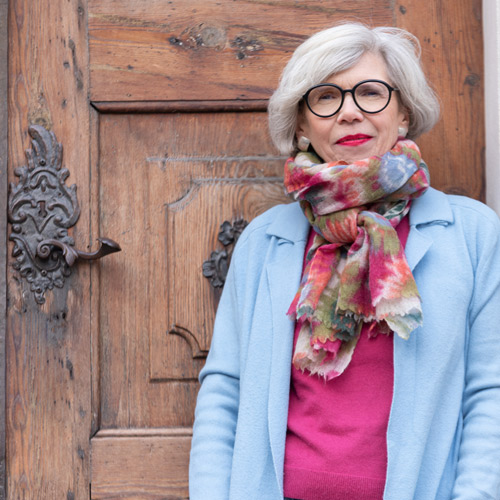
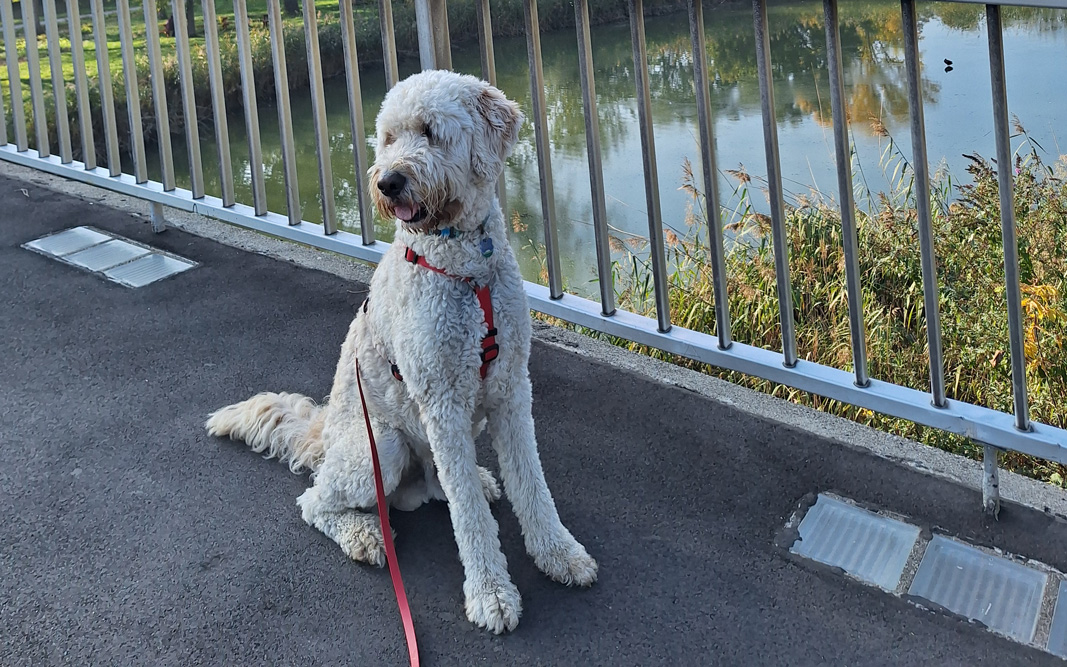
“Die Wienerin” has a dog.
As a visitor to my website, you may already know that. Rudy has accompanied me through my life for five years now and is always with me on my walks through the city. On tours with guests, the dog stays at home. He’s well behaved, but when he notices that I’m distracted, he sometimes gets silly ideas. I’d rather not tempt him.
All in all, Rudy is a good companion on my walks through the city. He now knows that I often like to stop to take a closer look at something and take photos. He can also pose nicely when a photo of a sight with a dog is required. Provided I don’t need too long to find the right angle.
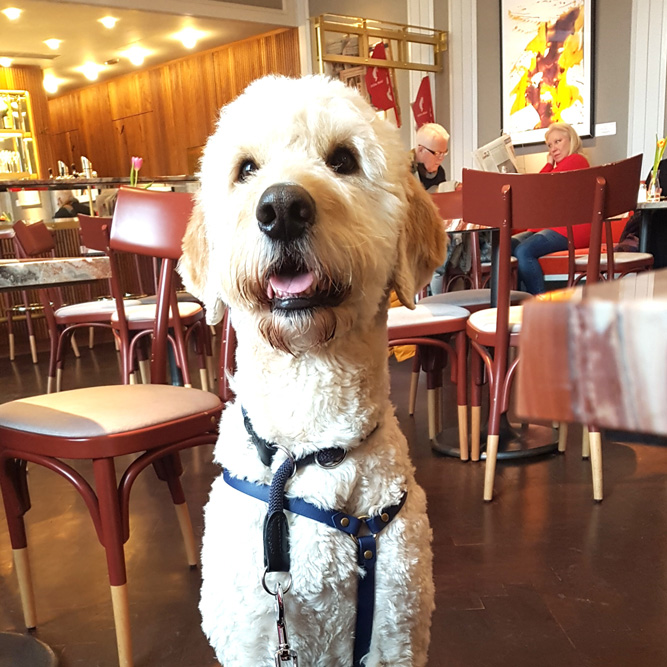
Rudy also knows how to behave in a coffee house. He learned this from an early age and insists on going to his regular hangouts. He knows that he can expect (at least) a dog biscuit and a friendly welcome. Conveniently, Rudy has exactly the same preferences when it comes to coffee houses as I do.
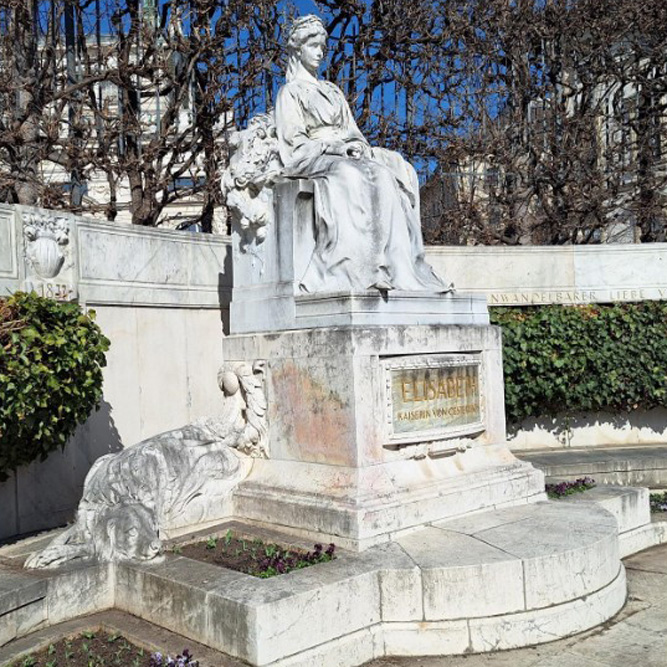
Many famous Viennese also had dogs. Empress Elisabeth, famous under her nickname Sisi, had a fondness for large dogs. One of her Leonbergers is immortalized on each side of her monument in the Volksgarten.
Rudy at the café in the Dorotheum auction house – one of our insider tips; you’ll always find a place here, cake is excellent and we’re given a very warm welcome
The Viennese love dogs.
They are part of the image of this city and we see them everywhere – on the street, in the parks, in stores and in cafés and restaurants. In some places they are not allowed – in grocery stores, pharmacies and in a few – very few – restaurants. Historic gardens are closed to dogs – these include the Volksgarten, the Burggarten and the gardens of Schönbrunn Palace and Belvedere Palace.
Many parks have dog exercise areas where dogs can run free and, if they can find a playmate, also romp around.
Vienna’s city center has some remarkable dog parks to offer:
At Vienna’s Heldenplatz, we have already encountered the Federal President Alexander van der Bellen twice with Austria’s First Dog Juli. In the Stadtpark, dogs are allowed to run along the Wien River – on the promenade of the beautiful historic Wien River embankment.
Overall, the inner-city dog parks are all rather small. For a real run, the Prater and the Danube Island are better places.
Outside the dog parks, dogs must either be kept on a lead or wear a muzzle on Viennese streets. In any case, a leash is compulsory in parks, and for certain dogs considered dangerous (so-called dangerous dogs), a leash and muzzle are mandatory everywhere.
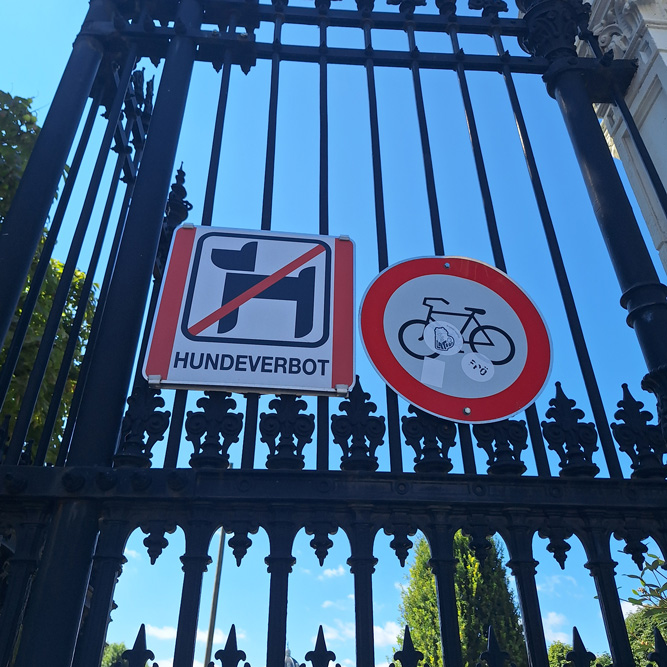
Unfortunately, dogs are not allowed in historic gardens.
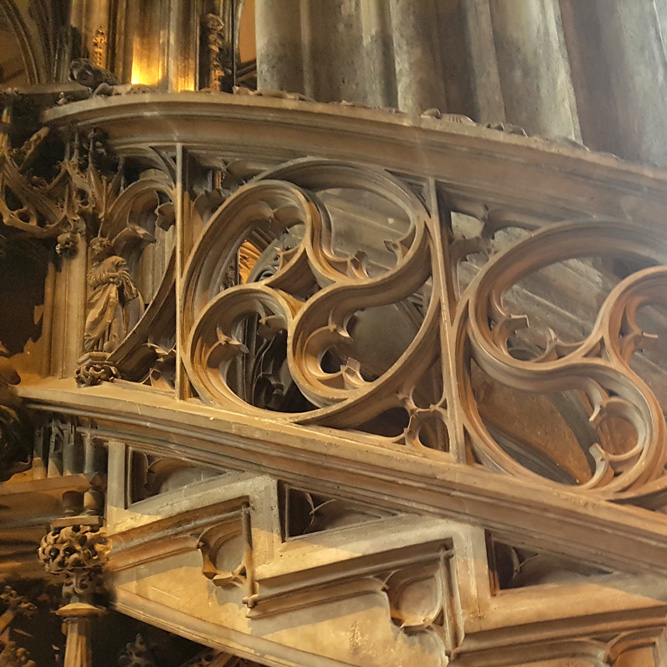
Dogs can be found in many places in Vienna. Right at the top of the stairs to the pulpit in St. Stephen’s Cathedral, the little “Dog without Fear” watches over the preacher and lets nothing bad come up to him.
Vienna dog walks
With the following dog walks I would like to give you a few suggestions on how you can combine a dog walk with getting to know Vienna. Of course, there are many, many other possibilities. Just ask the Viennese dog owners you meet along the way. You’re sure to get lots of good suggestions and tips. It’s easy to get into conversation with dog people.
City centre
Like most large cities, Vienna does not have many dog walking areas in the historic city centre. Dogs are not allowed in the historic parks (Burggarten, Volksgarten). In the Stadtpark there is a dog area along the Wien River, as well as at Heldenplatz near the Outer Palace Gate. Dogs are allowed to run free there and there are usually playmates to be found.
The morning hours are best for exploring the city centre with your dog, as even the busiest squares and alleyways are empty. An additional advantage is that you have the best opportunity to take beautiful photos of the sights at this time. And you’re sure to find a café open early for a Melange and a croissant – and if you’re lucky, a dog biscuit.
The dog area in the Stadtpark along the Wien River allows us to get to know an often overlooked part of this park better

Danube Canal
The Danube Canal is easy to reach from the city centre. Stairs at the Urania and Schwedenplatz lead to the car-free path along the river, which is shared by walkers, cyclists and dogs. Dogs are best kept on a lead here, but without the stress of car noise and crowded sidewalks.
The path along the Danube Canal offers you the opportunity to take a close look at the street art on one of the city’s legal graffiti sites (Wiener Wand).
Prater
The route to the Prater runs either along the Danube Canal or via Praterstrasse and Praterstern (easily accessible by subway). The Vienna Prater, the former hunting grounds of the Habsburgs, is a large landscaped park. The Prater Hauptallee is a favorite route for Vienna’s runners and equally popular with cyclists, so a leash is mandatory there. However, there is a large dog exercise area with meadows and forest paths that offers plenty of freedom and variety. After the walk, there is also a café nearby for dog owners to sit and rest.

Alte Donau/Old Danube
If you have a dog that can use the subway (a lead and muzzle are compulsory), you can take the U1 line to the Old Danube and choose from various routes. Your dog travels with a child ticket which can be purchased at the ticket machine in the station. There are largely car-free walking paths around the Upper and Lower Old Danube, and near the Wasserpark there is even a large dog park with access to the water. There are also plenty of places for dog walkers to stop for refreshments along the Old Danube. Dogs are equally welcome guests everywhere.
The Donaupark is also located on the Old Danube and is easily accessible by subway. Many walking paths (dogs on a lead) lead through the very different parts of the park, which was created for the Vienna International Horticultural Show in 1965. Its landmark, the 252-metre-high Danube Tower (Vienna’s tallest building), on which there is a revolving restaurant, also dates from that time.
Rudy in the Donaupark, not particularly interested in the tower.
Währinger Park, Türkenschanzpark
These two old Viennese parks in the 18th and 19th districts offer large dog areas with many amenities: Benches for people to sit on, water points for dogs, tree trunks lying around for dogs to jump on, shade and grass and also dog-friendly cafés for a break after a romp.
Währinger Park was created on the site of the abandoned Währing cemetery and opened in 1923. The former Währing Jewish cemetery is located near the dog area. This cemetery still has many culturally and historically valuable funeral monuments and is an important monument to Vienna’s city history and to the Jewish history in Vienna. The cemetery is not open to the public, but can be visited at certain times (without a dog).
The Türkenschanzpark is also located at a historic site. During the Second Siege of Vienna by the Ottomans in 1683, an Ottoman/Turkish redoubt was located here. It is assumed that the name of the park, which was opened to the Viennese population in 1888, goes back to this.
Danube Island
The dog area on the Danube Island can also be reached by streetcar via the Floridsdorf Bridge, although it is a little easier by car. The start is at the parking lot by the Floridsdorf Bridge and from there you continue along the water. Dogs like my Rudy, who like to cool off from time to time, are particularly happy there because there are several places to swim.
A stroll on the Danube Island reveals Vienna as a city on the water and opens up completely different perspectives than in the city centre
Vienna Woods
The Vienna Woods are of course also a paradise for walkers. Many starting points for longer and shorter walks can be reached by public transport. Please note that dogs must be kept under control at all times in the Vienna Woods and are therefore not allowed to run off the lead.
The Vienna Woods are also home to the highest mountain in the city of Vienna, the 544-metre Hermannskogel.
Dog vacation in Vienna – 10 x practical tips
1. Advance notice
Dogs are generally welcome in hotels and restaurants, cafés and also in wine taverns. It’s always easier if the dog is announced at the time of booking, especially if, like my dog, he or she does not like to lie under the table. We always ask for a corner seat where we cause as little disturbance as possible out of consideration for other guests and the staff.
2. The necessary equipment
A lead and muzzle are often, but not always, necessary. In most restaurants, the dog is simply allowed to be there. However, if there are other dogs nearby or a guest who does not feel safe around dogs, it is better for everyone to keep the dog on a lead. Bringing a blanket can make your dog more comfortable.
3. Water
Viennese water is of the very best quality and is safe to drink for people and animals everywhere (unless explicitely mentioned otherwise, e.g. historical fountains). Many Viennese hydrants have fixed dog bowls from which your dog can drink fresh and healthy water at any time. In a café or restaurant, your dog will be happy to be served water in a bowl. Don’t be afraid to ask for it.
4. Food supply
You will surely bring the right dog food with you when you travel. However, if you run out or need dog biscuits because your particularly well-behaved pet has already eaten everything: Dog food is on sale in Viennese supermarkets and drugstores and supplies can be easily replenished there.
5. Public transportation
Dogs are allowed to use all public transportation with a leash and muzzle. Small dogs traveling in a bag do not need to be additionally secured. Dogs that do not fit in bags require a ticket and travel at the same fare as children. A dog ticket, like yours, can be purchased from the ticket machines in the stations or on the streetcars.
6. Dog areas, dog parks
In most parks and large green spaces there are dog exercise areas where dogs are allowed to run around without a lead or muzzle. These dog areas of various sizes are always fenced in and marked with a sign.
7. A bag for the poop
You can find bags for dog waste all over the city – at garbage cans, in dog zones and in parks. They are free of charge. Please collect your dog’s droppings and dispose of the bag in one of Vienna’s many trash cans. Thank you!
8. Dog sitters
During your stay in Vienna, you may want to do something that your dog can’t do with you: visit a museum or theatre, go to a concert or an exhibition. You can find many offers for dog sitters and dog walkers in Vienna online. Please search and book in good time so that you can enjoy your program in peace while your dog is well looked after.
9. Heat and cold
Summers in Vienna are getting hotter and hotter and the city centre is a dog-unfriendly place. Vienna has a number of good hotels that are located just outside the city centre and close to parks or the water. Dogs are better off there than directly in the city centre, especially during the hot season, and at the same time you have good public transport connections to the sights.
In winter, black ice is a danger and the city of Vienna spreads road salt to prevent falls. This can be bad for sensitive dog paws. When traveling in winter, please remember to bring dog shoes or wet wipes and washcloths to clean your dog’s paws after a walk.
Should you be surprised by a cold snap in Vienna and your dog freezes: Numerous dog boutiques are available and you are sure to find a nice and warm coat for your dog.
10. Emergencies
Vienna has a dense network of veterinary practices throughout the city. You can find addresses and contact details online and your hotel will also be able to help you. For acute emergencies, at night and at weekends, the emergency outpatient clinic of the University of Veterinary Medicine is open for you. You can use a normal Viennese cab to transport your dog. However, this must be announced in advance, as not all drivers accept dogs. It is therefore best to reserve a cab by telephone.
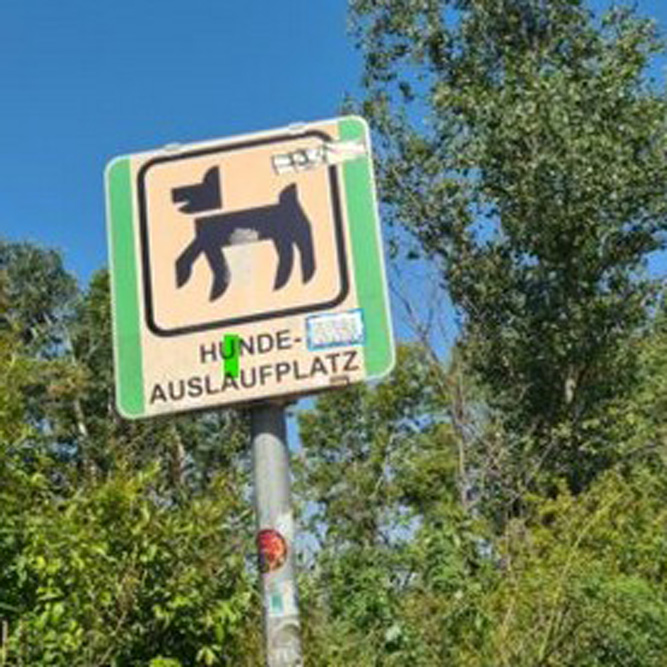
Free running without a leash is permitted here.
Tours of Vienna with dogs
Even though my dog stays at home while I am out and about with guests in Vienna, I am happy to welcome your dogs on a city walk. Your four-legged friends are welcome on private tours. The route can also be tailored to their needs, which I will be happy to plan together with you.
As a rule, city tours with dogs can only take place outdoors, as dogs are not allowed in museums, churches, palaces, etc. *) However, this is still a great way to explore the city. If you are interested in a guided tour with your dog, just send me a message. Thank you!
*)Where and under what conditions assistance dogs may be taken on visits, we must find out in each individual case in good time before the visit and preferably coordinate this with the individual museum etc.